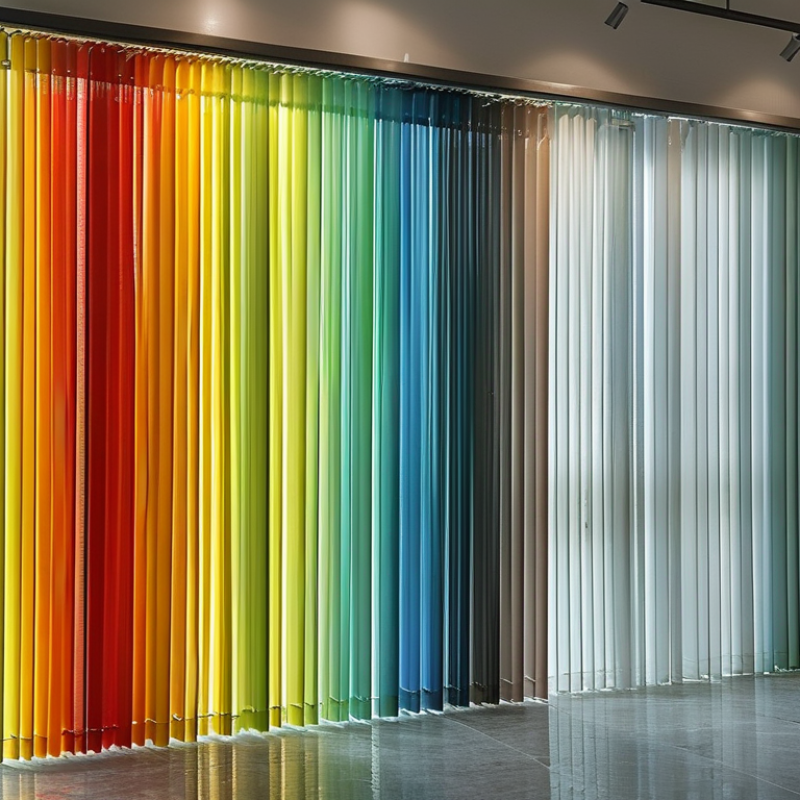
Choosing the right 3.5-Inch PVC Vertical Blinds involves more than comparing colors and online prices. Global buyers must examine material quality, light control, moisture resistance, operating systems, and supplier reliability. A blind that looks elegant in a showroom may warp beside a humid bathroom window. Small details matter.
Design expert Don Norman reminds buyers, “Design is really an act of communication.” This principle fits window treatments well. The slat width communicates a room’s visual scale, while the operating system affects daily comfort and safety. For this guide, we compare seven 3.5-Inch PVC Vertical Blinds for homes, offices, hotels, and commercial interiors.
Each selection deserves practical attention. Check whether the PVC feels rigid rather than brittle. Look for smooth rotation, consistent slat spacing, and a sturdy headrail. In coastal rooms, moisture and salt air can expose weak construction quickly. In sunny rooms, fading and heat buildup become important concerns.
Specifications can mislead. A low price may exclude installation hardware, replacement parts, or dependable after-sales support. Buyers should also confirm packaging strength before international shipping. Damaged slats create unnecessary delays and waste.
This comparison is useful, but not perfect. Product availability, certifications, and regional installation practices can change. Therefore, treat the rankings as a starting point, not a final decision. The best 3.5-Inch PVC Vertical Blinds should match the window, climate, budget, and everyday habits of the people using them.
For global buyers comparing 3.5-inch PVC vertical blinds, one measurement deserves careful attention. An 88.9 mm slat equals 3.5 inches, not 5 inches. A true 5-inch slat measures about 127 mm. This difference affects the blind’s appearance, stacking space, and required track length. Product drawings should state both inches and millimeters.
An 88.9 mm PVC slat offers a practical balance between privacy and daylight. When the slats overlap correctly, they reduce direct glare while allowing soft light through the room. Rotating them slightly can brighten a workspace without fully exposing the window. PVC also resists moisture, making it useful near kitchens, bathrooms, and humid coastal interiors. It still needs proper support.
Weight depends on more than width. Slat thickness, PVC density, surface texture, and total drop all matter. A longer blind can place noticeable stress on the carrier system. I recommend checking the weight per square meter before selecting a headrail. Measure twice.
From installation experience, uneven overlaps often cause unwanted light gaps. Small errors in cutting or spacing can become obvious at sunrise. A reliable specification should include slat width, thickness, overlap, total weight, light-control rating, and fire-performance information where required. The phrase “5-inch PVC blind” can be used loosely in some markets, which creates confusion. Buyers should request a physical sample and confirm the actual width before approving production.
For global buyers, 3.5-inch PVC vertical blinds should be evaluated against recognized safety benchmarks, not appearance alone. ANSI/WCMA A100.1 focuses on window-covering safety, especially hazardous operating cords and accessible loops. EN 13120 addresses internal blinds, including construction, operation, and safety performance. Requirements may differ by market.
A reliable supplier should provide recent test reports, product specifications, and traceable production records. Check the headrail, tilt mechanism, wand length, cord routing, and mounting strength. PVC slats should also be checked for cracking, sharp edges, odor, and dimensional stability after heat exposure. A compliant-looking sample is not enough. I have seen attractive samples fail during repeated operation testing.
Tips: Ask whether testing covered the exact 3.5-inch model, not a similar series. Confirm the applicable standard edition and testing laboratory. Request installation instructions in the destination language. Inspect packaging for warning labels and secure hardware. Also verify local fire, chemical, and consumer-safety rules, because ANSI/WCMA A100.1 and EN 13120 are benchmarks, not universal market approval. A small documentation gap can delay an entire shipment.
7 Best 3.5 Inch PVC Vertical Blinds for Global Buyers
Seven 3.5-inch PVC vertical blinds stand out when UV resistance, fire rating, and warranty terms are compared carefully. The first uses standard UV-stabilized PVC for bedrooms and shaded offices. The second adds stronger pigment protection, helping reduce fading beside bright windows. The third uses a thicker slat, offering better impact resistance in busy commercial areas. It may feel heavier during daily operation.
The fourth option combines UV protection with a documented flame-spread rating. The fifth uses low-smoke PVC, but buyers must verify local testing requirements before ordering. The sixth focuses on moisture resistance and suits humid apartments, coastal offices, and enclosed balconies. Its warranty should clearly cover cracking, discoloration, and warping. The seventh offers a longer limited warranty with reinforced carriers and durable headrail components. Read the exclusions carefully.
In real installations, sunlight exposure is rarely even. South-facing windows can fade faster than shaded rooms. I once treated warranty length as the strongest buying signal. That was too simple. A five-year warranty may exclude installation errors, commercial use, or color changes caused by extreme sunlight. Reliable suppliers should provide UV test evidence, fire documentation, material specifications, and replacement-part policies. Fire ratings also vary by country and building type, so certificates should match the project location. Ask for sample slats. Check the edges, surface texture, and operating noise before placing a large order.
Non-branded benchmark comparison by UV blocking, comparative fire performance, and warranty coverage.
UV blocking is shown as a percentage. Fire performance uses a comparative 1–5 index, where 5 indicates the strongest documented performance. Warranty values are shown in years. Buyers should verify supplier test certificates, local fire regulations, and written warranty terms before purchasing.
For global buyers, the seven best 3.5-inch PVC vertical blinds are not chosen by appearance alone. Energy performance matters more in rooms facing strong sunlight. A low U-factor means better resistance to heat transfer through the blind system. However, U-factor values may vary with glazing, airflow, and installation quality. Check the test method before comparing suppliers.
SHGC measures how much solar energy enters through the window. A lower SHGC usually helps reduce cooling demand in hot climates. Solar heat reduction is easier to understand: it shows how much sunlight the blind blocks. Dark PVC slats may absorb more heat, while lighter surfaces often reflect more radiation. Keep it practical.
In field checks, I would inspect closed slats at midday and measure indoor surface temperature. A small gap can weaken real performance. This is often overlooked. Ask for laboratory data, product tolerances, and installation instructions in the destination market. Thermal comfort also depends on window orientation, curtain-wall design, and local weather. No single metric tells the whole story. A blind with excellent laboratory results may perform poorly when slats do not overlap evenly or controls remain partly open. That is where careful review matters.
For global buyers, the seven best 3.5-inch PVC vertical blinds are not judged by appearance alone. Check slat width, material thickness, rotation quality, headrail strength, light control, cleaning ease, and replacement-part access. Measure the window recess, finished width, height, and available mounting depth. A small error can leave visible gaps.
Request installation drawings before ordering. Confirm whether the blind supports inside or outside mounting, and identify the required screws for concrete, timber, or drywall. Test the carrier movement by hand; it should glide without grinding. Safety needs equal attention. Choose designs with protected operating systems, secured chains, and no accessible loops near children. Local safety rules may differ, so ask for current test reports rather than relying on a sales statement.
Import paperwork also deserves careful review. Confirm the correct tariff classification with a customs professional, because PVC products may be classified differently by destination. Prepare a commercial invoice, packing list, product dimensions, country-of-origin details, and any required material or chemical compliance documents. Packaging should protect slat edges from crushing during long-distance transport. I have seen perfect samples arrive with bent headrails after weak carton testing. That mistake is avoidable, but not always predictable. Compare shipping volume, minimum order quantity, lead time, inspection options, and spare-part policy before payment. Leave room for local installation practices. They can challenge your original assumptions.
| Option | Typical Product Specification | Recommended Sizing Guidance | Light & Privacy Performance | Installation Notes | Safety & Compliance Checks | Import Documentation Checklist |
|---|---|---|---|---|---|---|
| 1. Standard White PVC | 3.5 in / 89 mm vertical slats; rigid PVC; commonly supplied with a headrail, carriers, chain, and control cord; matte white finish. | For inside mounting, measure the window recess at three points and use the smallest width and height. Allow clearance for free slat rotation and confirm the supplier's deduction policy. | Moderate light filtering with good daytime privacy when slats are closed. Overlap and vane rotation affect the final light gap. | Suitable for level ceilings and standard drywall, wood, or masonry surfaces when the correct screws and anchors are used. Check headrail level before tightening. | Use a cord tension device or an approved cordless control where required by the destination market. Keep operating cords away from beds, cots, and climbing areas. | Commercial invoice, packing list, transport document, country of origin, HS classification confirmed with a customs broker, material declaration, and installation instructions. |
| 2. Room-Darkening PVC | 3.5 in / 89 mm PVC slats with darker or light-blocking surface treatment; normally supplied in a solid neutral color. | Use an outside mount when the objective is to reduce side light leakage. Extend the blind beyond the opening only as far as the wall, trim, and handle clearances permit. | Higher light reduction than standard translucent PVC, but not fully blackout because light can pass through gaps, the headrail, and perimeter edges. | Verify that the stacked slats do not obstruct doors, radiators, window handles, or emergency egress routes. Use adequate wall blocking for heavy or wide assemblies. | Request evidence for flame performance only if the target project requires it; PVC fire classifications vary by formulation and test method and should not be assumed. | Add technical datasheet, test reports applicable to the destination, PVC composition statement, packaging details, and any required import permit or labeling information. |
| 3. Moisture-Resistant PVC | 3.5 in / 89 mm waterproof PVC slats designed for humid rooms; smooth surface for easier wiping; color and finish should be confirmed by sample. | Measure after tile, trim, and sealant work is complete. Leave enough clearance to prevent slats from rubbing wet surfaces or bathroom fixtures. | Usually provides moderate privacy and light control. Moisture resistance does not automatically mean resistance to discoloration, heat, or chemical cleaners. | Use corrosion-resistant fasteners in humid locations. Do not install where the headrail or control mechanism will be directly exposed to continuous water spray. | Confirm the product is intended for indoor use and request cleaning limitations. Avoid abrasive cleaners that can damage the PVC surface or coating. | Include material and chemical declarations where requested, product care instructions, moisture-use limitations, invoice, packing list, and origin information. |
| 4. Textured or Wood-Look PVC | 3.5 in / 89 mm embossed or printed PVC slats with a wood-look or textured appearance; supplied with matching hardware where available. | Order a physical sample before approving color because printed texture and batch variation can appear different under natural and artificial light. | Light filtering and privacy are generally similar to standard PVC of the same slat profile; texture mainly changes appearance and surface feel. | Check that the textured face is oriented consistently during installation. Avoid bending slats sharply, especially in cold conditions. | Ask for surface-finish durability information if the blinds will be exposed to strong sunlight. Do not claim UV or fire performance without supporting test evidence. | Provide product photos, approved sample reference, finish description, packaging and carton marks, invoice, packing list, origin, and any destination labeling requirements. |
| 5. Wide-Opening Commercial Set | 3.5 in / 89 mm PVC slats configured for wider windows or sliding doors; headrail length and stack side must be specified before production. | Confirm finished width, finished height, split draw, stack position, and required overlap. Large openings may require multiple linked headrails or a center split. | Provides adjustable privacy and daylight control. A larger opening can create more visible gaps at the center, sides, and stack area. | Use a fixing schedule suited to the substrate and distribute brackets evenly. Check maximum recommended headrail length and carrier load with the supplier. | For public or commercial interiors, verify local requirements for accessible controls, child safety, flame performance, and maintenance records before purchase. | Add installation drawings, carton dimensions and gross weight, spare-parts list, warranty terms, inspection requirements, and project-specific compliance documents. |
| 6. Cordless or Chain-Controlled Set | 3.5 in / 89 mm PVC slats using a cordless wand, chain control, or another specified operating method; configuration varies by market. | Confirm the control side, control length, operating clearance, and whether the selected mechanism is available for the required blind width and height. | Light control is determined mainly by slat opacity, overlap, and rotation; the operating mechanism does not by itself improve light blocking. | Test the control action before final fixing. Ensure the wand or chain does not strike nearby furniture, handles, or door panels during operation. | For child-accessible areas, confirm compliance with the applicable destination-market window-covering safety standard and request documented test results. | Specify operating method on the purchase order and include safety labels, user instructions in the required language, test reports, invoice, packing list, and origin details. |
| 7. Custom-Cut Project Set | 3.5 in / 89 mm PVC slats cut to ordered dimensions with selected color, stack direction, control type, and mounting method. | Submit a measurement sheet showing opening width and height, mounting type, reveal depth, obstructions, stack side, and finished dimensions. Approval should be obtained before cutting. | Performance depends on the selected slat opacity, overlap, and installation accuracy. Custom cutting normally cannot be returned for measurement errors. | Request a pilot unit or pre-production drawing for large orders. Inspect headrail operation and slat alignment before bulk shipment when practical. | Confirm tolerances, product-use environment, safety labels, installation warnings, and destination-market requirements in writing before production. | Prepare purchase specification, approved drawing, commercial invoice, packing list, HS code confirmation, origin statement, carton marks, warranty, and compliance file. |