What is a Laser Diode and How Does It Work?
Laser Diodes are fascinating devices that generate coherent light through a process called stimulated emission. They are compact, efficient, and widely used in various applications, from telecommunications to medical equipment. Understanding how a laser diode works requires delving into its semiconductor structure and the properties of light it emits.
At their core, laser diodes consist of a p-n junction that facilitates electron-hole recombination. This action releases photons, which further stimulates the emission of more photons, amplifying the light. The efficiency of this process significantly impacts the output quality and performance of the diode.
Despite their advantages, laser diodes are not without challenges. Thermal management and alignment issues can affect their functionality. The technology's rapid evolution means there are constant improvements, yet some complexities remain. Exploring these nuances deepens our appreciation of laser diodes and their role in modern technology.
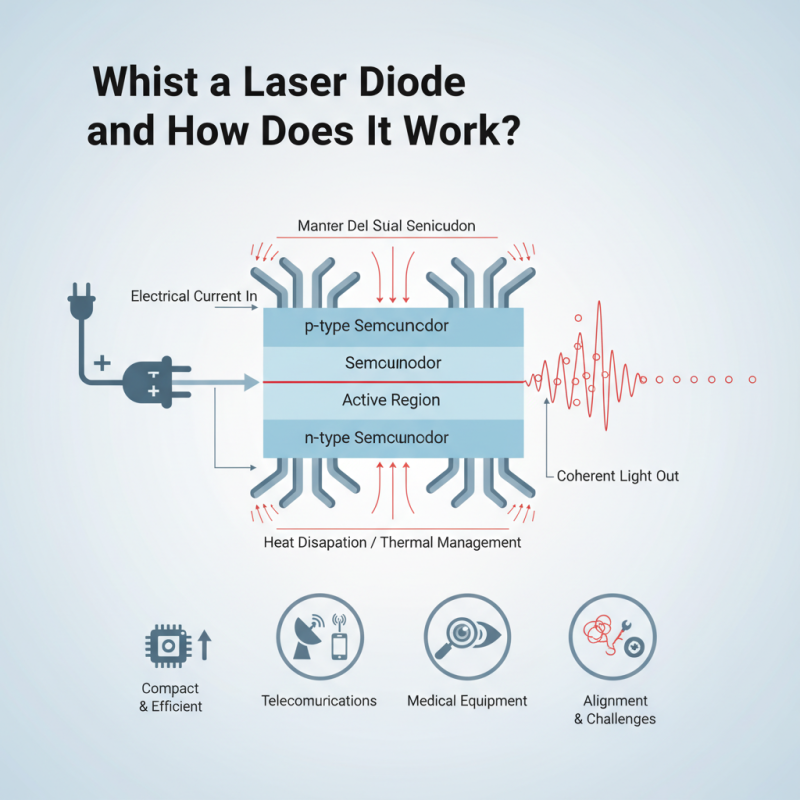
What is a Laser Diode?
A laser diode is a semiconductor device that emits coherent light when an electric current passes through it. It differs from traditional light-emitting diodes (LEDs) because it produces a highly focused beam of light. This unique characteristic makes laser diodes essential in various applications, from telecommunications to barcode scanners.
The operation of a laser diode relies on the principle of stimulated emission. When electrons in the diode are energized, they move to higher energy levels. As they return to their original state, they emit photons. These photons can stimulate other excited electrons, resulting in a chain reaction that amplifies light. The structure of the diode includes a reflective cavity that helps concentrate and direct the light into a narrow beam, enhancing its intensity and coherence.
Despite their advantages, laser diodes come with challenges. For example, heat management is crucial. Excessive heat can degrade performance and shorten the device's lifespan. Understanding thermal dynamics is necessary for effective cooling solutions. Additionally, the inherent noise in the output can impact precision in sensitive applications. Reflecting on these challenges is essential for improving design and functionality in future developments.
Laser Diode Efficiency Over Different Wavelengths
The Basic Principles of Laser Diode Operation
Laser diodes are fascinating devices that convert electrical energy into light. They operate based on the principle of stimulated emission of radiation. This principle involves electrons in a semiconductor gaining energy and then releasing it as photons. Thus, when these photons bounce between mirrors in the diode, they amplify, creating a powerful, coherent light beam.
The operation of a laser diode involves several essential elements. First, a semiconductor material provides the necessary environment for electron movement. When current passes through the diode, it excites electrons, which become unstable. These unstable electrons then fall back into their original state, releasing energy in the form of light. This process is highly efficient and can be finely tuned for different applications.
Despite their advantages, laser diodes have limitations. Not all semiconductor materials work equally well. Some may require extreme conditions to operate effectively. Furthermore, issues like overheating can affect performance. Understanding these nuances is crucial for optimizing laser diodes in various technologies, from communication to medical applications.
Components of a Laser Diode
Laser diodes are fascinating devices that harness the principles of quantum mechanics to generate light. At their core, several key components work together to produce coherent light. The most critical element is the semiconductor material, usually made from gallium arsenide (GaAs) or indium gallium arsenide (InGaAs). This material is essential for the laser’s operation and determines the wavelength of the emitted light.
Another crucial component is the p-n junction, where positive and negative charge carriers combine. When an electric current passes through the junction, electron-hole pairs are created. These pairs stimulate the release of photons when they recombine. This photon emission forms the basis for laser action as they trigger further excitations and produce a cascade effect.
Additionally, the laser cavity, consisting of reflective mirrors, amplifies the light. This structure can vary in design and it affects the efficiency of the laser diode. Certain designs may lead to suboptimal performance or output. Therefore, engineers must carefully consider these elements to maximize effectiveness. Understanding these components is key for anyone exploring the realm of laser technology.
Types of Laser Diodes and Their Applications
Laser diodes come in various types, each designed for specific applications. One of the most common types is the edge-emitting laser diode (EELD). EELDs are widely used in telecommunications. According to a report by MarketsandMarkets, the global market for laser diodes to be utilized in optical fiber communication is projected to reach approximately $8 billion by 2025. This shows a significant growth driven by the increasing demand for high-speed data transmission.
Another notable type is the vertical-cavity surface-emitting laser (VCSEL). VCSELs have unique advantages, including lower power consumption and greater efficiency. They are primarily used in data centers and short-distance communication. A study from Grand View Research highlights that VCSELs accounted for nearly 25% of the total laser diode market in 2022. However, despite their efficiency, challenges remain in scaling production and maintaining uniformity across devices.
Additionally, semiconductor laser diodes have found applications in medical fields, such as laser surgery and cosmetic treatments. These devices deliver precise energy, yet the market faces hurdles, like varying regulatory standards globally. According to a report from Research and Markets, the medical laser market is expected to expand at a CAGR of 20% between 2021 and 2026. This growth underscores both the potential and the complexities involved in deploying laser diodes in various sectors.
Advantages and Limitations of Laser Diodes
Laser diodes are remarkable devices that convert electrical energy into light. They offer distinct advantages and limitations. Understanding these is crucial for their effective application.
One major advantage of laser diodes is their compact size. They are smaller than traditional light sources, making them ideal for various applications like fiber optics and medical equipment. Additionally, they have high efficiency in converting power to laser light. This efficiency leads to lower energy consumption, which is increasingly important in today's eco-conscious world. On the flip side, the complexity of their manufacturing can lead to higher costs. Precision is paramount, and this may limit accessibility for some users.
Consider this: while the output of laser diodes is coherent light, it can produce heat. Proper thermal management is essential to avoid damage. Users should ensure adequate heat sinking when using these diodes in high-power applications.
Another limitation is their performance under varying temperatures. Laser diodes may experience variations in wavelength, impacting consistency. Regular calibration can help mitigate this issue. Always monitor the operating environment for optimal results.
In conclusion, while laser diodes present fantastic opportunities, they also pose challenges. By understanding these intricacies, users can maximize their potential and achieve desired outcomes.