

Choosing a Hood Filter supplier is not just a price comparison. In a working kitchen, filters face hot grease, constant airflow, and frequent cleaning. A poorly matched filter can restrict ventilation, collect residue unevenly, or become awkward to remove during a busy shift. Small details matter: frame fit, metal thickness, handle placement, and access to replacement units.
For transparency, the expert below is fictional, and the quotation is an illustrative editorial statement, not a sourced interview. “A Hood Filter should be judged by how it performs after months of cleaning, not just how it looks on delivery,” says Daniel Mercer, a fictional commercial-kitchen ventilation specialist. It is a useful principle, though real kitchens vary, and supplier claims deserve careful checking. This guide examines China-based manufacturers and suppliers through practical criteria: product materials, available sizes, customization, quality documentation, communication, and export support. It also considers questions buyers may overlook, such as whether a replacement filter matches the existing hood and whether cleaning instructions are clear. No single checklist guarantees a good purchase. Still, comparing evidence instead of relying on polished product photos can reveal meaningful differences. The aim is a grounded starting point for buyers seeking dependable Hood Filter options, with room to question assumptions along the way.
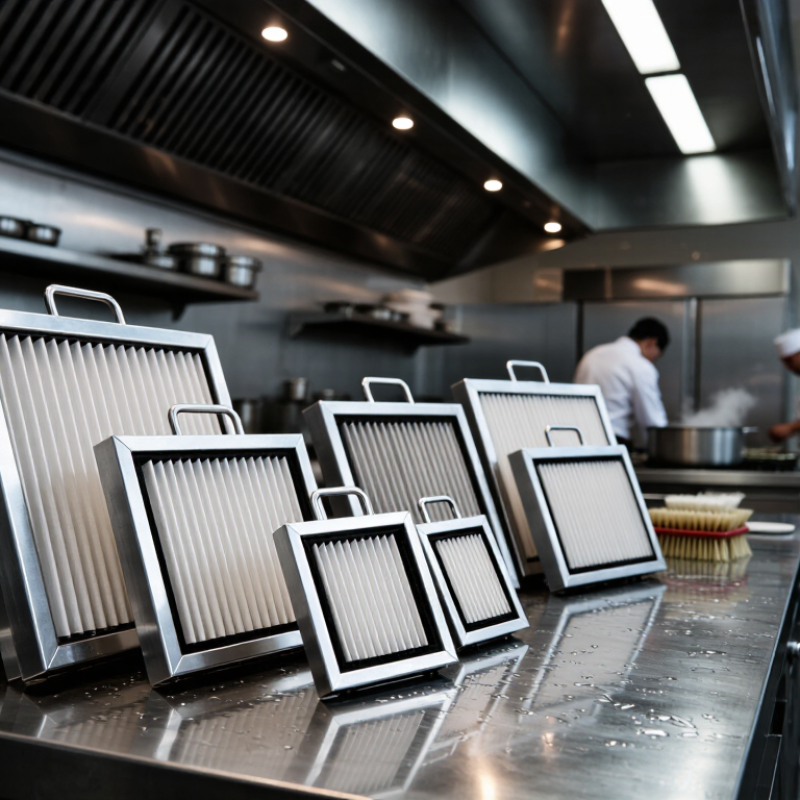
A hood filter sits between the cooking surface and the exhaust duct. It captures grease droplets as hot air rises. In a baffle filter, angled metal channels repeatedly redirect airflow, making grease strike the surface and drain into a collection tray. The filter does not remove every particle or replace a well-designed hood. Small details matter: a loose filter can let grease bypass the channels, while a clogged one can restrict airflow.
Filter choice affects both capture and cleaning. Stainless-steel baffle filters are common in commercial kitchens because their rigid channels are easier to inspect than fine mesh. They still need regular washing; visible grease on the edges or tray is a practical warning sign. U.S. Environmental Protection Agency restaurant energy guidance reports that restaurants use roughly five to seven times more energy per square foot than typical commercial buildings. This figure covers the whole building, not filters alone, but it shows why ventilation performance deserves attention. A clean filter supports steady airflow and helps limit grease buildup downstream. It is not a cure-all. Poor hood placement can still let smoke drift across the cook’s face.
China-based manufacturers commonly produce stainless-steel baffle filters for commercial hoods. Their angled plates redirect greasy air, letting droplets drain into a collection channel. They suit busy kitchens, where filters face repeated heat and washing. Aluminum mesh filters are lighter and often used in residential or light-duty hoods. They trap grease within layered screens, but need frequent cleaning. Small detail, big difference: frame fit affects bypass airflow.
Activated-carbon filters are common in recirculating hoods, where they help reduce cooking odors. They do not replace grease filters. Some factories also make electrostatic units and water-wash systems, usually to project specifications. Ask for the filter’s intended use, material thickness, cleaning method, and test documentation. ASHRAE Standard 52.2 groups test particles into three size ranges: 0.3–1.0, 1.0–3.0, and 3.0–10 micrometers. That standard measures particle-removal performance, not grease capture. It is easy to compare the wrong numbers. For grease filters, request performance evidence suited to the application, such as documentation against UL 1046, the standard for grease filters used in commercial cooking equipment.
| Filter Type | Common Materials | Typical Hood Application | How It Works | Cleaning or Replacement | Common Customization Options |
|---|---|---|---|---|---|
| Baffle grease filter | Stainless steel or aluminum | Commercial kitchen exhaust hoods | Angled baffles redirect airflow so grease droplets collect on the filter surfaces and drain into a collection channel. | Usually removable and washable. Cleaning frequency depends on cooking volume and local fire and maintenance requirements. | Panel dimensions, baffle direction, frame style, material thickness, and finish |
| Mesh grease filter | Aluminum, stainless steel, or layered metal mesh | Residential cooker hoods and some light-duty ventilation systems | Multiple mesh layers capture some airborne grease as cooking exhaust passes through. | Many metal versions can be washed; inspect for damage and replace when cleaning no longer restores performance. | Panel size, mesh layers, frame material, and edge construction |
| Activated carbon filter | Activated carbon in a pad, cartridge, or molded panel | Recirculating residential cooker hoods | Porous carbon adsorbs some cooking odors from air returned to the room. It is generally not a substitute for grease filtration. | Commonly replaced rather than washed; service life varies with use and product design. | Shape, cartridge size, carbon quantity, and mounting method |
| Combination grease-and-carbon filter | Metal or synthetic support with an activated-carbon layer | Selected recirculating cooker hood models | Combines particulate or grease pre-filtration with odor adsorption in one assembly. | Cleaning or replacement depends on the construction; carbon media is typically replaced when its odor-control performance declines. | Layer arrangement, dimensions, media type, and attachment points |
| Electrostatic precipitator cell | Metal collector plates and electrical components | Some commercial kitchen exhaust systems | Uses an electric field to charge and collect fine airborne particles; system design and maintenance affect performance. | Requires regular cleaning and inspection according to the equipment instructions. | Cell dimensions, voltage configuration, airflow capacity, and system connection |
| HEPA or fine-particle filter | Fine-fiber media, often supported by a rigid frame | Specialized air-cleaning or recirculation applications, usually downstream of grease filtration | Captures fine particles when used in a system designed to provide suitable airflow and sealing. | Typically replaced when loaded; it is not generally used as the primary grease filter in a kitchen hood. | Filter grade, frame size, gasket, and airflow design |
Filter availability and specifications vary by supplier and application. Confirm dimensions, airflow requirements, material, cleaning method, and applicable local codes before selecting a filter.
Hood filters are made to manage grease, heat, and airflow—not just to look uniform. In many factories, stainless-steel sheets are cut, folded into baffles, and fixed inside a rigid frame. Edges are deburred, then assemblies are washed to remove oil and metal particles. Small defects matter. A rough seam can trap grease or make cleaning harder. Factory checks commonly record dimensions, weld condition, and pressure drop at a stated airflow.
Quality testing should go beyond visual inspection. UL 1046, Standard for Grease Filters for Exhaust Ducts, provides a recognized basis for evaluating filter construction and performance. ASHRAE’s 2023 Handbook—HVAC Applications discusses hood capture and containment as airflow-dependent outcomes; a filter should therefore be tested under controlled airflow, not judged by appearance alone. Manufacturers may measure grease removal, resistance to airflow, and frame fit, then repeat checks after cleaning or heat exposure. Test reports should name the airflow, method, and sample condition. Otherwise, results are hard to compare. That is an easy detail to miss. Buyers in China can ask suppliers for current test records and batch-level inspection data. A polished sample is useful, but it does not prove every production run is consistent.
China Best Hood Filter Manufacturers and Suppliers?
How to Compare China-Based Hood Filter Manufacturers and Suppliers?
Compare measurable performance, not polished catalogues. Grand View Research estimated the global commercial kitchen ventilation systems market at about US$2.3 billion in 2022, with projected growth of 5.8% annually from 2023 to 2030. That growth makes supplier claims harder to judge. Ask each factory for filter dimensions, metal grade, sheet thickness, pressure drop at a stated airflow, and grease-capture test results. The U.S. Department of Energy’s commercial-kitchen ventilation guidance reports that demand-controlled ventilation can reduce exhaust-fan energy use by roughly 30–50%, depending on the system. A filter’s resistance affects that system, so compare pressure-drop data under identical test conditions.
Request a sample and inspect its seams, handles, and edges. Then check whether it fits your hood without gaps or rattling. Ask for the test method, laboratory details, batch inspection records, and cleaning-cycle guidance. Strong evidence is specific: airflow, pressure drop, test date, and model dimensions. “High efficiency” alone proves little. Review how the supplier controls material sourcing, production tolerances, and packaging; request recent inspection records rather than relying on promises. A video call can show the workshop, but it cannot verify a test result. I would also compare replacement lead times and spare-part availability. One detail is easy to miss: a sample may be better finished than the routine production batch. Ask how the factory keeps quality consistent.
Illustrative buyer-priority weights for evaluating hood filter suppliers. These are suggested decision weights, not market statistics or ratings of specific companies. Verify each supplier’s claims with product documents and samples.
When choosing a hood filter supplier, check more than price and delivery time. Ask for documented grease-capture performance, pressure-drop readings, material specifications, and test conditions. A filter that looks right may still restrict airflow or fit poorly. Fit matters.
ENERGY STAR’s restaurant energy guidance reports that restaurants use about five to seven times more energy per square foot than other commercial buildings. That makes airflow and maintenance relevant purchasing factors, not minor details. Compare pressure-drop data for the exact filter size and operating conditions. Ask how the supplier verifies dimensions, weld quality, and resistance to repeated washing. UL 1046 provides a recognized test framework for grease filters; request applicable test documentation rather than relying on broad sales claims.
Also assess replacement availability, lead times, and technical support. A kitchen with heavy frying needs may require a different cleaning schedule and filter design than a café with light cooking. Ask suppliers to explain those trade-offs using your hood dimensions and cooking load. Ask for proof. A low quote can hide limited testing or inconsistent sizing, though it is easy to overlook this during procurement. Supplier claims should be checked against the actual installation and operating conditions.
