How to Find China Best Training Room Furniture Suppliers?
Finding China’s best Training room furniture suppliers requires more than comparing prices on a marketplace. The right partner must understand how people learn, move, collaborate, and concentrate. Dr. Kenn Fisher, a learning-space researcher, has said, “Learning spaces should support the activities and behaviors that learning requires.” That principle matters when reviewing chairs, folding tables, mobile whiteboards, and modular desks.
A credible supplier should provide clear factory information, material specifications, product drawings, and realistic lead times. Ask whether the tables can be rearranged quickly for group exercises. Check whether chair casters move smoothly on your flooring. Inspect edge finishing, frame stability, upholstery quality, and cable management. Small details become obvious after six hours of training.
Experience also matters. Request photographs of completed projects, sample units, and references from schools, companies, or conference facilities. A factory audit, video inspection, or independent quality check can reveal more than polished catalog images. Confirm packaging standards, replacement-part support, warranty terms, and communication procedures before placing a large order.
No supplier is perfect. Even experienced manufacturers may miss a color detail, delay a sample, or misunderstand a drawing. That is why disciplined documentation matters. Share floor plans, seating targets, usage scenarios, and acceptance standards in writing. Then test the furniture before approving mass production.
The cheapest quote may become expensive after repairs, shipping damage, or poor ergonomics. A dependable Chinese supplier should offer transparent communication, consistent quality, and practical customization. This guide explains how to compare those factors and choose Training room furniture that works in real training environments, not only in product photographs.
Define Your Training Room Furniture Requirements
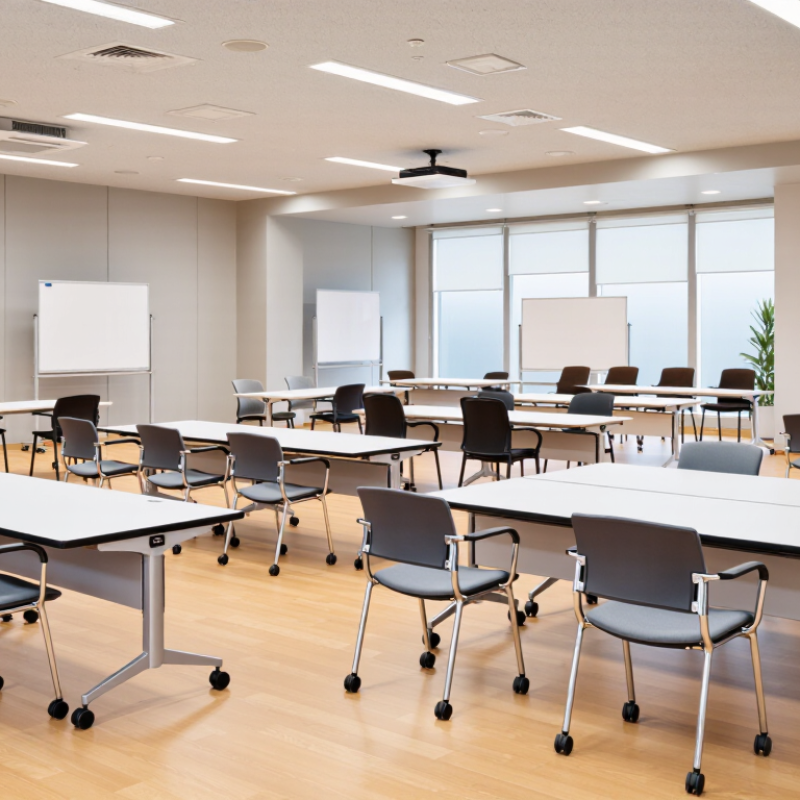
Before contacting suppliers, define how the training room will be used. Count the learners and note whether sessions involve lectures, group work, or hands-on practice. Record room dimensions, doorways, columns, and power outlets. Measure twice. A table that fits on a floor plan may still block a door when chairs are pulled back.
Decide what each seat needs to support. For a room used all day, check chair adjustability, back support, and easy-clean surfaces. For group exercises, choose tables that can be moved and rearranged without heavy lifting. Specify storage needs too: laptops, cables, paper, and teaching materials all need a place. Small details matter. If the room is shared, stackable chairs may help, but they can feel less comfortable during long sessions.
Set practical requirements before comparing supplier quotes. List preferred materials, approximate quantities, delivery access, assembly needs, and a realistic budget range. Ask suppliers for dimensions, load ratings, care instructions, and written details about warranties. These checks make offers easier to compare and reduce guesswork. Still, requirements can change after people use the room. Leave some flexibility in the plan; a perfect specification on paper is not always perfect in practice.
Identify Reliable Chinese Supplier Channels
How to Find China Best Training Room Furniture Suppliers?
Identify Reliable Chinese Supplier Channels
Reliable supplier channels begin with focused research, not the lowest online quotation. Use established business directories, furniture trade fairs, and qualified sourcing agencies. These channels usually provide clearer company records and product categories.
Request the supplier’s business license, workshop address, export history, and production photos. A video factory tour is useful, but an independent audit is stronger. Check whether the factory controls cutting, welding, upholstery, and final inspection internally. Ask for recent references with similar training room projects. Be careful here. Some impressive catalogues show products the factory does not actually produce.
Samples reveal details that brochures hide. Inspect frame stability, edge finishing, seat comfort, folding mechanisms, and packaging strength. Request material specifications and test reports for relevant safety and durability requirements. A dependable supplier explains limitations instead of promising everything. Communication matters too. Compare quotation speed, drawing accuracy, revision discipline, and answers to technical questions.
Keep records. Use a written specification sheet, approved sample, inspection schedule, and clear delivery terms. A small trial order can expose packing problems or inconsistent colors before a large purchase. Payment arrangements should protect both parties and follow applicable commercial laws. My own preference is steady verification over rushed trust. The cheapest channel often becomes expensive when replacements, delays, and unclear responsibilities appear.
Assess Supplier Experience, Production Capacity, and Quality
Finding China’s best training room furniture supplier requires more than comparing prices. Experience should appear in evidence. Ask for completed projects with similar layouts, chair quantities, folding tables, cable access, and delivery deadlines. A supplier serving training centers should explain how it manages room reconfiguration, not just show polished photographs. Grand View Research estimated the global office furniture market at about USD 54 billion in 2023, with continued growth expected through 2030. That demand attracts capable factories, but also inexperienced traders. Check the legal company name, factory location, export history, and customer references. Do not rely on a catalog alone.
Production capacity must match your peak requirement. Request monthly output, key equipment, workforce details, and the production schedule for your order. Walk through the cutting, welding, upholstery, assembly, and packing areas, either in person or through a live video audit. A factory may claim high capacity while outsourcing critical work. That is a warning sign. Review material purchasing records and ask how shortages are handled. I would also request a small pilot order before committing to a container. It costs more time, but exposes weak communication early.
Quality should be measurable. Require drawings, material specifications, load-test records, inspection plans, and pre-shipment reports. Use recognized requirements, such as ISO 9001 systems and applicable seating or table safety standards. Third-party inspection can verify dimensions, welds, surface finish, carton strength, and random product quantities. The AQL approach is useful, though it is not a substitute for design testing. A spreadsheet helps. It can still hide bad workmanship. Leave room for independent testing and honest review after the first delivery.
Compare Furniture Options, Pricing, and Service Terms
When sourcing training room furniture in China, compare function before appearance. Folding tables save storage space, while fixed tables provide stronger stability for daily use. Nesting chairs improve room changes, but casters may raise maintenance needs. Test it first. Check edge finishing, frame thickness, load capacity, and cable access with sample units.
Grand View Research reported that the global office furniture market reached about USD 58 billion in 2023, with continued growth expected through 2030. This expansion increases supplier choice, but also creates uneven specifications. Request itemized quotations for tables, chairs, acoustic panels, delivery, installation, and spare parts. A low unit price can become expensive after packaging and replacement costs. I have found that a clear bill of materials prevents many disputes.
Pricing should be compared on total cost, not the factory quotation alone. The 2024 Global Office Fit-Out Cost Guide shows that labor, logistics, and regional installation conditions strongly affect workplace project budgets. Ask suppliers to state currency, tax treatment, production time, warranty length, and payment stages. Service terms deserve equal attention. Require inspection photos, carton standards, replacement procedures, and response times for defects. A spreadsheet alone can mislead. Suppliers should also explain whether custom colors or dimensions change the warranty. Some offers look polished but leave these details unclear. That is a weakness worth recording.
Verify Supplier Credentials and Choose the Best Fit
A reliable training room furniture supplier should prove more than a polished catalog. Request its business license, factory address, export history, and recent audit records. The ISO Survey 2022 recorded more than 300,000 ISO 9001 certificates in China, but certification alone does not guarantee consistent furniture quality. Ask for the certificate number, issuing body, and matching company name.
Inspect a sample chair, folding table, and cable-management unit before placing a large order. Check welds, edge finishes, caster movement, laminate thickness, and packaging protection. Request test reports for load capacity, fire performance, and formaldehyde emissions where applicable. The 2023 Global Office Furniture report from CSIL places China among the world’s largest office furniture production bases, yet factory scale can hide weak after-sales control. That part is easy to miss.
Use a written scorecard. Compare response speed, sample accuracy, defect handling, lead time, and spare-part support. A supplier should explain its quality checkpoints with photos or inspection records. Verify production capacity through a live video call, not only edited images. Some suppliers look professional online. Reality may be less tidy. Ask for two recent customer references and contact them independently. Check whether the supplier can adapt layouts, power access, acoustic needs, and local safety requirements. A low quotation may reflect thinner materials, not better efficiency. Reconsider it.